ColabaseAI logoColabaseAI logoColabaseAI
  • Inspiration
  • History
  • Assets
  • Favorites
  • Generate
  • All Prompts
  • World Cup
  • Product & Brand
  • Poster Design
  • Photography
  • Illustration & 3D
  • Food & Drink
  • UI & Graphic
Terms of Service·Privacy Policy
Prompt

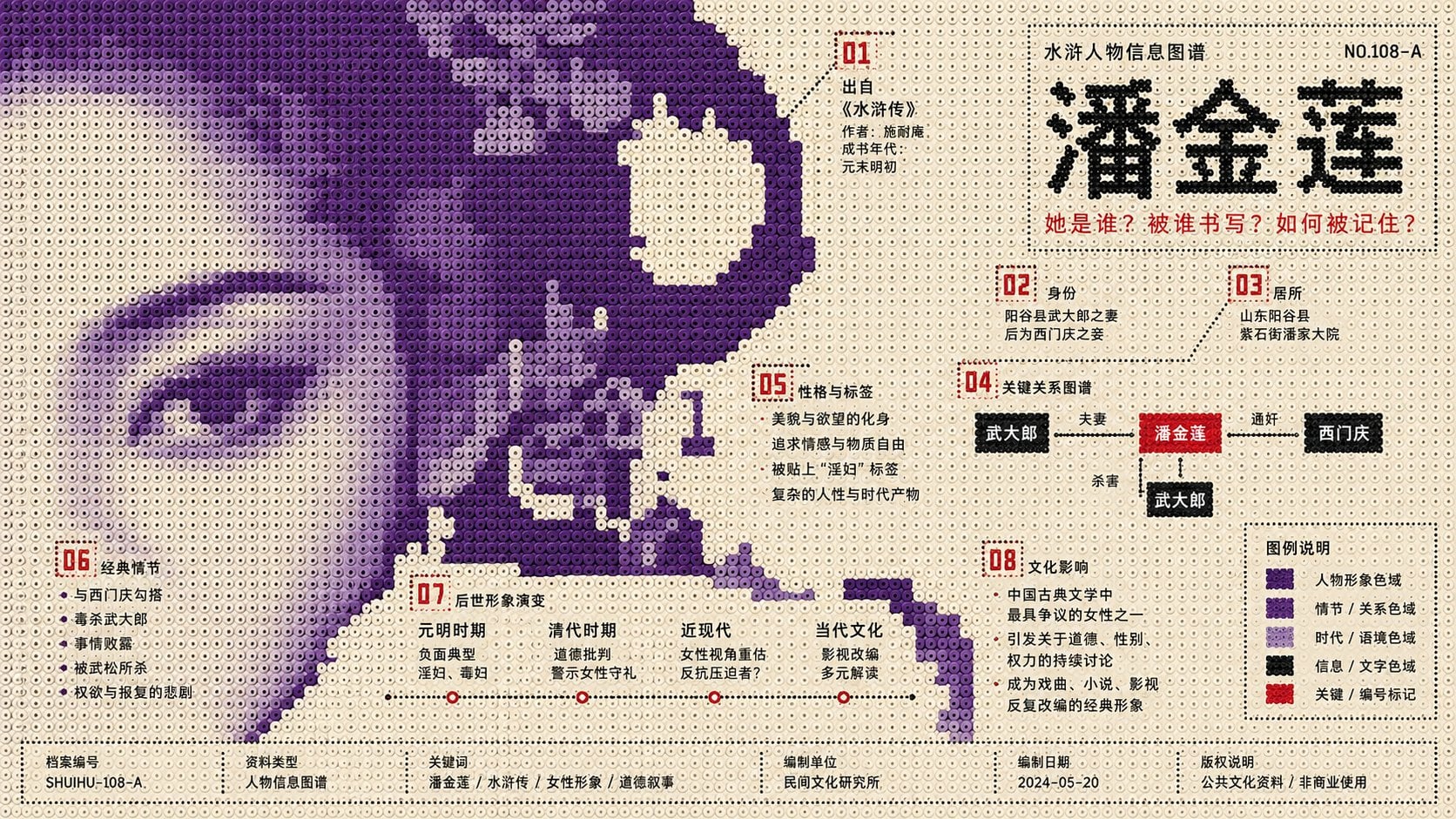
Pan Jinlian Perler Bead Infographic Poster

Generated Image Preview

Pan Jinlian Perler Bead Infographic Poster1 / 3
知识
知识猫图解
@GeekCatX
HomepageView original post
12.7KViewsMay 28, 2026
Model / Categories / LicenseGPT ImagePoster DesignUI & GraphicCC BY 4.0

Infographic AI Image Prompt

Prompt

Generate a 16:9 horizontal infographic poster.

Theme: Pan Jinlian

Must cover knowledge points:
Knowledge Point 1
Knowledge Point 2
Knowledge Point 3
Knowledge Point 4
Knowledge Point 5
Knowledge Point 6
Knowledge Point 7
Knowledge Point 8

Visual style definition:
This is a structured flat infographic poster in the style of "Perler beads / fuse beads / pixel bead array". The image is composed of a large number of regularly arranged circular plastic Perler beads, each with a clear circular boundary, a slight central dimple, uniform spacing, low-saturation plastic texture, and stable grid order. The overall composition must maintain an orthographic flat view, like a public cultural infographic poster made of Perler beads, not toy photography, 3D models, cartoon illustrations, or regular pixel art.

Core composition:
Compress the main subject "Pan Jinlian" into a large-scale monochrome Perler bead image field, rather than a complete realistic object, a centered illustration, or a collection of icons. The subject must flow in from the edge of the frame, cross the page boundary, and be cropped, like a fragment of a larger Perler bead medium entering the paper. The subject occupies the main visual weight but is not fully presented; the audience must reconstruct the theme through its outline, direction, missing areas, bead density, and local texture.

Subject form:
The outer edge of the subject exhibits low-resolution Perler bead steps, block breaks, hard-cut notches, pixelated jagged outlines, missing bead sections, and sampled rough boundaries. Smooth silhouettes are forbidden, complete icon outlines are forbidden, and realistic details are forbidden. The interior of the subject uses only Perler beads of different lightness from the same structural color, forming low-contrast image fragments, halftone noise, scan grain, material afterimages, archival textures, and local density variations.

Background and negative space:
The background uses a high-lightness, light-colored Perler bead field, resembling unprinted paper, a light off-white plastic base, or a pale gray-white Perler bead array. The background is not a decorative base color but actively cuts into the subject, forming large voids, winding channels, quiet text windows, reading pause areas, and knowledge point containers. The blank space must be like air, and also like a knife edge; it provides a sense of breathing and also cuts the subject's structure. Large light areas and large subject structural colors must interpenetrate; they cannot be simply divided into upper and lower sections, nor can they become a regular background.

Color system:
Employ a strict three-layer functional color scheme; averaged coloring is not allowed.

First layer: Light background field
Area proportion approximately 60%–70%. Function: breathing, cutting, pausing, carrying text windows. Colors can be old paper white, light off-white, cool gray-white, pale blue-white, or light warm gray.

Second layer: Subject structural color
Area proportion approximately 25%–35%. Function: forming the subject, creating spatial pressure, expressing the subject's emotion and material semantics. The color must be chosen according to "Pan Jinlian"; for example, a cool theme could use deep blue, dark green, gray-purple, graphite; a warm theme could use ochre red, earthy orange, brown-black, dark gold. Within the structural color, variations in Perler bead lightness can express granular density and image afterimages.

Third layer: High-contrast information color
Area proportion approximately 3%–6%. Function: titles, numbers, time, annotations, institutional information, legends, footnotes, and key knowledge point markers. Information colors must be sparse, sharp, and clear, using red, black, bright blue, fluorescent orange, or high-purity cyan. Information colors must not spread as decorative colors.

Infographic system:
Convert all Knowledge Point 1 to Knowledge Point 8 into Perler bead information nodes; do not use ordinary icon stacking for explanation. Each knowledge point is presented in one of the following forms:
- Small numbered label
- Miniature annotation box
- Perler bead legend block
- Coordinate line
- Time scale
- Scale bar
- Directional arrow
- Archival index number
- Local texture description
- Edge marker point

Information nodes must be dispersed along blank windows, color field boundaries, cut nodes, subject gaps, negative space channels, and the bottom edge. There must be 8 information nodes, corresponding to the 8 knowledge points. All information nodes must have a hierarchy: main title largest, core concepts secondary, knowledge point labels smaller, footnotes and numbers smallest. Information nodes must not cover the subject's center, nor disrupt the large color field structure.

Reading path:
Construct a jump-style reading path: small markers at the top → main title sideways → knowledge points at the subject's edge → negative space annotation windows → footnotes and legends at the bottom. The image must satisfy both distant recognition and close reading: from afar, it is a strong, large Perler bead image fragment; up close, it is a precise, orderly knowledge information system.

Font and text:
Use narrow modern sans-serif fonts, Swiss-style sans-serif, clear skeletal fonts, or monospace metadata fonts. Font strokes are even, kerning is restrained, and hierarchy is precise. The main title is like public cultural information coordinates, small text like archival metadata indexes. Text must be arranged in blank windows, boundary nodes, and the bottom information bar, not over the subject's center. Text must be clear, concise, and labeled, avoiding long paragraphs.

Theme translation rules:
Do not directly use default icons to explain "Pan Jinlian". Time, place, function, relationships, data relationships, causal relationships, or abstract concepts within the theme must be translated into:
- Perler bead color field density
- Direction of missing bead areas
- Edge pressure
- Negative space shapes
- Information node positions
- Numbering system
- Local texture differences
- Perler bead lightness hierarchy
- Legend color block relationships

Perler bead material:
All visual elements are composed of Perler beads. The Perler bead surface has a matte plastic texture, with slight manufacturing imperfections, subtle grain, minor wear, and low-contrast surface differences. Within structural color areas, halftone-like Perler bead density variations, a scanned output feel, an uneven old paper feel, and a spot color overprint feel may appear. Information color beads must have sharp edges, clear contrast, and precise positioning.

Overall atmosphere:
The overall image should resemble a structured public cultural infographic poster reconstructed from Perler beads. It is not a cute handmade illustration, nor a children's toy style, but a restrained, rational, modern, archival, information-dense yet clearly ordered visual system. The image should have the feel of a museum exhibition poster, a research institution infographic, public cultural wayfinding, and experimental graphic design.

Hard composition requirements:
- 16:9 horizontal
- Orthographic flat view
- Clear circular Perler bead particles visible
- Subject enters from the image edge
- Subject cropped by the page boundary
- Large structural color blocks and large blank areas interpenetrate
- Outer contour shows Perler bead pixel steps
- At least 8 knowledge point information nodes
- Strong graphic impact from afar
- Precise information order up close
- Blank areas must participate in narrative and cutting
- Information color only for key text and markers

Prohibited content:
No complete realistic objects.
No centered subject illustrations.
No cute cartoon style.
No regular pixel art.
No 3D toy photography.
No depth of field blur.
No real camera photography feel.
No strong shadows.
No glowing effects.
No metallic highlights.
No complex decorative backgrounds.
No icon-stacked infographics.
No evenly distributed colors.
No text covering the subject's center.
No meaningless information noise.
No treating knowledge points as random decoration.
No excessive skeuomorphism.
No real photo collages.
No gradient flares.
No cyber neon backgrounds.
No soft illustration style.
No watercolor, oil painting, thick paint, 3D rendering styles.

Final effect:
The image should present as a high-end Perler bead style structured infographic poster. "Pan Jinlian" is not directly drawn but compressed into huge Perler bead color fields, pixelated bead array edges, missing bead voids, negative space knife edges, numbered nodes, archival annotations, and granular order. The audience sees a strong abstract thematic impact from a distance and can read the complete knowledge structure via information nodes up close.

Use this Prompt