ColabaseAI logoColabaseAI logoColabaseAI
  • Inspiration
  • History
  • Assets
  • Favorites
  • Generate
  • All Prompts
  • World Cup
  • Product & Brand
  • Poster Design
  • Photography
  • Illustration & 3D
  • Food & Drink
  • UI & Graphic
Terms of Service·Privacy Policy
Prompt

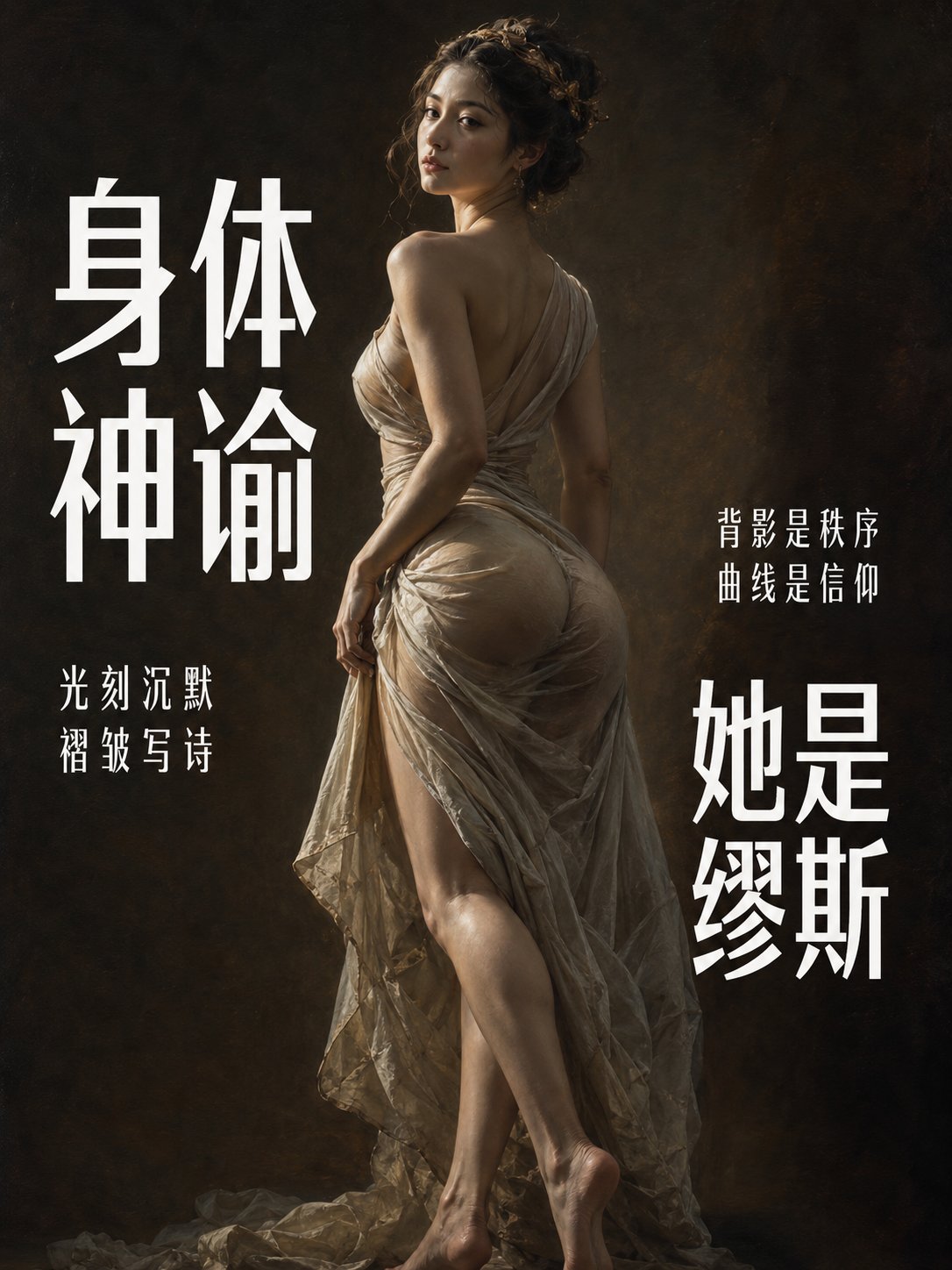
Classical Goddess Poster

Generated Image Preview

Classical Goddess Poster1 / 4
知识
知识猫图解
@GeekCatX
HomepageView original post
204.6KViewsMay 31, 2026
Model / Categories / LicenseGPT ImageIllustration & 3DPhotographyPoster DesignUI & GraphicCC BY 4.0

AI Image Prompt

Prompt

Subject Description: Full-body classical goddess figure, adult female, high-definition close-up to medium shot. Overall demeanor: elegant, austere, divine, solemn, emphasizing mature and restrained female body beauty. Exquisite facial features, calm, detached, serene expression, not vulgar, not exaggerated, no modern photoshoot-style expressions. Classical hairstyle, can be ancient Greek or Roman style curls, updos, tied hair, or natural long hair with a classical sculptural feel. Idealized body proportions, highlighting the following structural relationships: elegant curve from shoulder to neck to ribcage, clearly cinched waist, clear transition from pelvis to hips, rounded, voluminous buttocks, slender legs with distinction between weight-bearing and relaxed leg, torso, waist, hips, buttocks, legs forming a continuous S-curve. Pose mature, elegant, powerful, not vulgar or cheap-sexy. Visual focus always on: complete female figure, elegant pose, clear body curves, form-fitting sheer robe, strong visual poster aesthetic. Composition Rules: Vertical composition, 3:4 aspect ratio. Head fully in frame, body presented as completely as possible from head to calves or ankles. Close-up cropping is allowed, but must retain: head, shoulders and neck, waist, hips, buttocks, and main leg lines. Camera angle can be front, 3/4 side, half-back, slight low-angle, or slight high-angle, but must not distort body proportions. Compositional focus on the main body line, not a facial close-up. Head is present but not dominant; body posture, waist-hip relationship, fabric drapery, and light/shadow are the visual core. Minimalist background, no clutter, no modern props, no superfluous decorations. Body Display Rules: Pose must primarily serve to showcase the female body curves. Must clearly present: shoulder, neck, and collarbone structure, transition from ribcage to waist, narrowest point of the waistline, pelvis and hip transition, buttock volume and leg extension, continuous flowing S-curve, clearly balanced standing or sitting pose structure. Limbs can be involved in the action, but must not obscure the following key areas: waist, abdomen, hips, buttocks, main leg lines. Actions must have a classical demeanor, not stiff, not modern posed, not exaggeratedly dance-like, not anatomically distorted. Clothing Rules: Wearing a form-fitting, lightweight, clearly draped classical robe or drapery. Fabric must flow along the body structure, clearly outlining key contours such as the waist, pelvis, buttocks, and thighs. Robe cinches at the waist, then naturally expands at the hips, buttocks, and thighs. Folds should create a sense of direction based on the action, e.g., stretched, diagonally pulled, falling downwards, wrapped around the body, waterfall-like drape. Fabric must not be heavy, and must not completely obscure the main body lines. Pose Library: Regardless of the chosen pose, ensure: head is complete, main body lines are clear, waist, hips, buttocks, and legs are not obscured. Choose one or combine two of the following: 1) Classic Contrapposto stance: one leg bears weight, the other naturally bent. Shoulders and pelvis tilt in opposite directions, waist slightly twisted, one hip bone protruding, forming an elegant S-curve. 2) Arm-raised stretch: one or both arms raised, wrists near the top of the head or lightly touching hair. Ribcage lifted, waist and abdomen elongated, waistline cinched, fabric taut, clearly showcasing the curve from waist/abdomen to buttocks. 3) Leaning against a pillar: body lightly leaning against a stone pillar, wall, or background edge. Ribcage open, upper body slightly reclined, one hand lightly touching the support, the other hand naturally hanging or gathering fabric. The support object must only be an aid and not obscure the body. 4) Twisted torso looking back: body 3/4 turned to the side, head slightly looking back. Shoulders, neck, ribcage, waist, pelvis form rotational layers, one hip protruding, clear lines of buttocks and legs. 5) Half-back display: body half-turned to the back, head turned to the side revealing part of the facial profile. Focus on showcasing the back, side waist, dimples of Venus, buttocks, and back of the legs. 6) Leaning forward to adjust robe: body slightly leaning forward, hands or single hand adjusting draped fabric. Back, waist, buttocks form a continuous arc, fabric falling to create strong vertical folds. 7) Single leg stepping forward: one leg lightly stepping forward, the other bearing weight. Pelvis naturally shifts, body presenting a classical balance of stillness and movement. 8) Gathering robe to emphasize hips: hands lightly gathering fabric at the waist, side of thigh, or near the hips. Fabric is gently lifted then re-draped, creating form-fitting folds, enhancing waist-hip-buttock-leg proportions. 9) Reclined stretch: ribcage slightly elevated, head gently tilted back or to the side. Abdomen elongated, waistline clear, buttocks naturally lowered, creating a solemn tension like a divine statue. 10) Seated twisted pose: figure seated on a minimalist plinth, stone platform, or low stage. One leg bent, one leg naturally hanging or extended forward, upper body slightly twisted, maintaining clear waist and pelvis relationship. 11) Knee-raised on step: one foot placed on a low step, the other leg standing and bearing weight. Pelvis creates a height difference, waist twists accordingly, forming a stronger S-curve. 12) Side-body shoulder touch: one hand lightly touching shoulder, collarbone, or hair, the other hand naturally hanging or holding fabric. Body turned to the side, pose quiet, subtle, classical. Random Chinese Poster Text Rules: Overlay white Chinese bold text on the image, creating an avant-garde art poster effect. The text is variable, resembling art exhibition titles, fashion magazine cover lines, avant-garde poetry, or cool visual slogans. The text should be in extra-large white Chinese bold font, covering the image. 2-4 groups of text can be vertical, horizontal, or mixed. At least one group should be an extra-large title, occupying 1/4 to 1/3 of the image height. Other text should be small to medium size, densely arranged. Text can overlap with the figure but must not obscure the face, waist, hips, or main leg lines. Use pure white font, no outlines, no gradients, no colors, no shadows. Avoid garbled text, English text, brand names, dates, QR codes, contact info, or fixed repetitive sentences. Mode Switching Rules (Key Optimization): Must choose one of the two modes, do not mix. This step is crucial for optimization, otherwise the model may conflict between 'stone sculpture' and 'real skin'. Mode A | Cold White Sculpture Black and White Mode: Visual Definition for Mode A: Full-body classical marble goddess sculpture, black and white high-contrast art photography style. Figure is a sculpture, not a living person; skin, hair, and fabric are all made of stone sculpture material. Material is cold white or grayish-white marble, with fine stone texture, slight carving marks, and natural wear. Overall aesthetic like museum sculpture photography, black and white art exhibition posters, avant-garde magazine covers. Lighting and Photography for Mode A: Pure black and white, no color. High-contrast photography, strong shadows, strong highlights. Museum side lighting or top-down oblique lighting, subject brightly lit, background darkened. Light creates clear light-dark divisions along the face, shoulders and neck, ribcage, waistline, pelvis, buttocks, legs, and fabric folds. Overall minimalist, high-end, austere, divine, strong sculptural feel. Material Additions for Mode A: Skin is not skin, but stone surface. Hair is sculpted curls or updos. Robe is thin stone fabric. No real skin tone. No living details like blood color, skin pores, moist lips. Negative Constraints for Mode A: Avoid real skin texture. Avoid oil painting colors. Avoid modern fashion photography feel. Avoid warm-toned skin. Avoid realistic fleshiness. Mode B | Realistic Painted Mode: Visual Definition for Mode B: Classical goddess figure, but no longer a stone sculpture; instead, a lifelike realistic painted figure. Overall high-fidelity realistic painting, classical oil painting realism, or hyperrealistic digital painting style. Visually retains divinity, classicism, solemnity, and poster aesthetic, but the figure has skin texture like a real person. Figure Material for Mode B: Figure is a living female, not a sculpture. Skin exhibits realistic and delicate texture: soft skin tone layers, subtle warm and cool variations, fine skin texture, subtle pore texture, slight skin reflections, natural light and shadow transitions on collarbones, shoulders, arms, abdomen, hips, and thighs, subtle subsurface scattering, natural blood color and texture variations on lips, around eyes, bridge of nose, and collarbones. Overall should be as realistic as real skin, but still idealized, restrained, high-end, without influencer-style beauty filters or commercial sexy photoshoot feel. Clothing and Material for Mode B: Figure wears a lightweight fabric classical robe, silk or linen-like drapery. Fabric is still form-fitting, draped, and flows along the body structure, but is no longer stone-like. Fabric surface can have: subtle fiber texture, soft creases, delicate highlights, translucent or sheer feel, softly bright in direct light, layered in backlighting. Clothing must continue to serve the clear display of the waistline, pelvis, buttocks, and thighs. Hair and Face for Mode B: Hair can be: classical curls, updo, half-updo, slightly natural flowing hair. Hair has realistic strand texture, not sculpted stone hair. Facial features exquisite, calm, solemn, with divinity. Expression quiet, detached, restrained, no exaggerated emotions. Color Rules for Mode B: Use a limited color palette, maintaining high-end restraint. Recommended tones: ivory white, off-white, skin tones, dark gold, grayish-blue, deep brown, wine red, olive gray, smoky gray, low-saturation warm-cool contrast in dark backgrounds. Prohibit high-saturation, gaudy colors. Overall aesthetic like classical oil painting, modern high-end painted posters, art book covers. Lighting and Visuals for Mode B: Can use: classical oil painting style side lighting, soft spotlight, Caravaggio-esque chiaroscuro, subtle dramatic lighting, delicate control of skin and fabric highlights. Lighting should emphasize: facial bone structure, collarbones and shoulders/neck, narrowest point of the waist, pelvis transition, buttock and leg volume, fabric adherence structure. Overall texture should be like: realistic painting + classical mythological figure + high-end poster design + real skin texture visual. Aesthetic Control for Mode B: Sexuality comes from: body structure, light and shadow on skin and fabric, restrained tension of the pose, not from excessive nudity, exaggerated breasts/buttocks, or vulgar provocation. Must be high-end, artistic, restrained, with divinity and aesthetic distance. Negative Constraints for Mode B: Avoid stone sculpture material. Avoid black and white monochrome. Avoid real photography snapshot feel. Avoid overly strong modern makeup. Avoid influencer-style skin smoothing. Avoid plastic skin. Avoid over-saturation. Avoid eroticism. Avoid modern commercial fashion editorial feel. Avoid cartoonish, anime, or childish illustration feel. III. General Negative Constraints (Common to Both Modes): Avoid headless composition. Avoid cropped head. Avoid facial distortion. Avoid incorrect body proportions. Avoid extra limbs. Avoid stiff poses. Avoid limbs obscuring the waist, abdomen, hips, buttocks, and main leg lines. Avoid cluttered backgrounds. Avoid modern props. Avoid text obscuring the face and main body lines. Avoid garbled text. Avoid English text. Avoid fixed, repetitive text. Avoid text outlines, shadows, gradients, and colored text. Avoid vulgar photoshoot feel. Avoid excessive nudity. Avoid exaggerated or distorted actions.

Use this Prompt