ColabaseAI logoColabaseAI logoColabaseAI
  • Inspiration
  • History
  • Assets
  • Favorites
  • Generate
  • All Prompts
  • World Cup
  • Product & Brand
  • Poster Design
  • Photography
  • Illustration & 3D
  • Food & Drink
  • UI & Graphic
Terms of Service·Privacy Policy
Prompt

Fresh Pasta Making Storyboard

Generated Image Preview
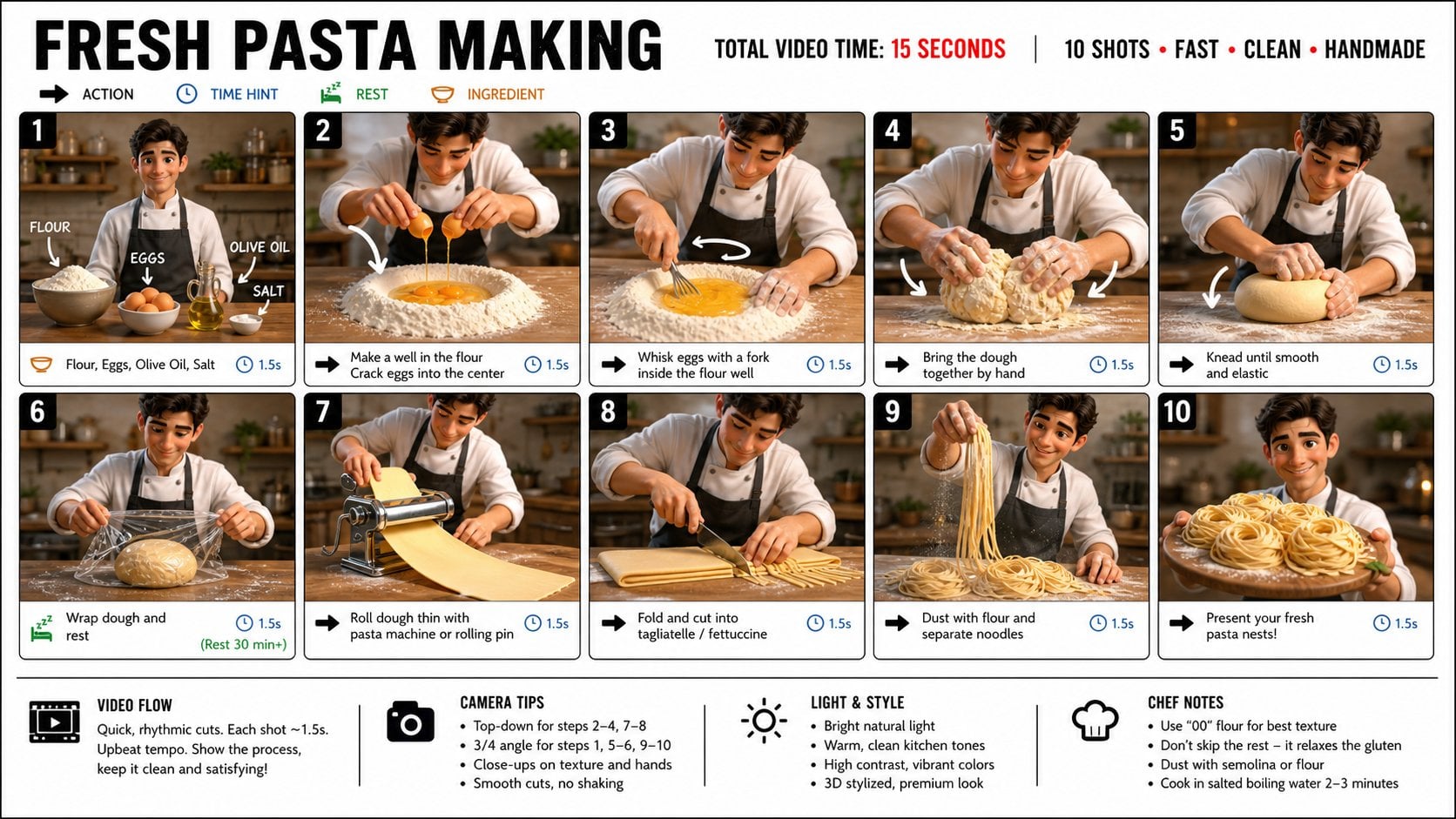
Fresh Pasta Making Storyboard
DR
Dheepan Ratnam
@Dheepanratnam
HomepageView original post
1.6KViewsMay 8, 2026
Model / Categories / LicenseGPT ImageFood & DrinkIllustration & 3DUI & GraphicCC BY 4.0

Infographic AI Image Prompt

Prompt

Create a clean, high-resolution infographic/comic-style cooking tutorial storyboard sheet for FRESH PASTA MAKING.Use a wide 16:9 layout, white background, bold black headings, black panel borders, premium 3D stylized rendering, and a clean instructional aesthetic designed like a 15-second recipe choreography guide.Use the same young male chef throughout: dark brown wavy hair, expressive friendly face, white chef jacket with black buttons, dark apron, warm clean kitchen environment in the panel imagery. Keep the chef visually consistent across all 10 panels.Top header:- Large bold title: FRESH PASTA MAKING- Add a header block: TOTAL VIDEO TIME: 15 SECONDS- Under it: 10 SHOTS • FAST • CLEAN • HANDMADE- Add a simple legend row with icons and labels for: ACTION, TIME HINT, REST, INGREDIENTLayout:Arrange 10 numbered panels in 2 rows of 5.Each panel should include:- Black number box- Bold panel title- Small time hint like 1.5s- Clean 3D chef action illustration- Motion arrows or process arrows where helpful- Short instructional caption at the bottomPanel sequence — follow exactly:Panel 1 — INGREDIENTS READYChef presents ingredients on a counter with clear labels:- flour- eggs- olive oil- saltCaption: Flour, Eggs, Olive Oil, Salt.Panel 2 — MAKE A WELLChef makes a flour well and cracks eggs into the center.Caption: Make a well in the flour. Crack eggs into the center.Panel 3 — WHISK INSIDE WELLChef uses a fork to whisk the eggs inside the flour well.Caption: Whisk eggs with a fork inside the flour well.Panel 4 — BRING TOGETHERChef brings the dough together by hand.Show motion arrows suggesting folding inward from the flour edges.Caption: Bring the dough together by hand.Panel 5 — KNEADChef kneads the dough into a smooth round ball.Caption: Knead until smooth and elastic.Panel 6 — WRAP & RESTChef wraps the dough and shows it resting.Add a note: Rest 30 min+Caption: Wrap dough and rest.Panel 7 — ROLL DOUGHChef rolls the dough into a long thin sheet using a pasta machine or rolling pin.Caption: Roll dough thin with pasta machine or rolling pin.Panel 8 — CUT PASTAChef folds and cuts the dough into tagliatelle / fettuccine.Caption: Fold and cut into tagliatelle / fettuccine.Panel 9 — DUST & SEPARATEChef lifts and separates fresh noodles, lightly dusted with flour.Caption: Dust with flour and separate noodles.Panel 10 — PRESENT PASTA NESTSChef presents finished fresh pasta nests on a board or tray.Caption: Present your fresh pasta nests!Footer:Add a clean footer with 4 sections:1. VIDEO FLOW — “Quick, rhythmic cuts. Each shot ~1.5s. Upbeat tempo. Show the process, keep it clean and satisfying!”2. CAMERA TIPS — “Top-down for steps 2–4, 7–8. 3/4 angle for steps 1, 5–6, 9–10. Close-ups on texture and hands. Smooth cuts, no shaking.”3. LIGHT & STYLE — “Bright natural light. Warm, clean kitchen tones. High contrast, vibrant colors. 3D stylized, premium look.”4. CHEF NOTES — “Use 00 flour for best texture. Don’t skip the rest — it relaxes the gluten. Dust with semolina or flour. Cook in salted boiling water 2–3 minutes.”Visual style:- White background- Strong black typography- Clean instructional design- Premium 3D stylized chef and food rendering- Warm clean kitchen scenes inside the panels- Highly readable and visually satisfying- 16:9 aspect ratioCreate a beautiful 15-second cinematic cooking tutorial video based exactly on the provided reference storyboard image.Follow the storyboard sequence without skipping, reordering, or inventing extra steps. The video should feel like the comic-style recipe sheet has come alive as a polished, premium 3D cooking video.STYLE:High-quality stylized 3D animation, bright clean white kitchen background, soft natural studio lighting, appetizing food colors, premium cooking-show aesthetic, clean camera movement, smooth transitions, realistic steam and food motion, charming friendly chef performance. Keep the same chef design from the reference: young modern chef, white chef jacket, dark apron, neat brown hair, expressive friendly face. Keep character consistency throughout all shots.FORMAT:15 seconds total. 10 clear shots. Each shot should last about 1.5 seconds. Use quick clean cuts. Keep every step readable. The viewer must understand the recipe sequence visually without text.SHOT SEQUENCE — FOLLOW EXACTLY:SHOT 1 — MISE EN PLACE, 0.0–1.5sMedium shot of the chef presenting the ingredients on a clean counter: pasta, tomatoes, garlic, basil, olive oil, salt, pepper. Chef smiles and gestures toward the ingredients. Keep it bright, organized, and appetizing.SHOT 2 — SALTED BOIL, 1.5–3.0sCut to a pot of boiling water on the stove. The chef sprinkles salt into the rolling boil. Show steam rising and water bubbling clearly. Camera angle: 3/4 close-up.SHOT 3 — CHOP GARLIC & BASIL, 3.0–4.5sTop-down or 3/4 close-up of the chef finely chopping garlic on a wooden board, then a quick visible motion of basil being roughly chopped. Clean knife movement, safe hand position, crisp food detail.SHOT 4 — ADD PASTA, 4.5–6.0sChef lowers dry spaghetti into the boiling salted water. The pasta bends and slides into the pot. Steam, bubbles, and a small stirring motion should be visible.SHOT 5 — SAUTÉ GARLIC, 6.0–7.5sClose-up of olive oil pouring into a skillet, then garlic sizzling gently. Chef moves the pan slightly. Show warm shimmer, small sizzling movement, no burning.SHOT 6 — BUILD SAUCE, 7.5–9.0sChef adds tomatoes into the skillet and stirs with a wooden spoon. The tomatoes crush into a vivid red sauce. Show sauce texture, steam, and gentle simmer.SHOT 7 — RESERVE & DRAIN, 9.0–10.5sChef reserves a small cup of pasta water, then drains pasta through a colander. Show water draining clearly. Keep motion clean and fast.SHOT 8 — TOSS TO COAT, 10.5–12.0sChef adds pasta into the tomato sauce and tosses it with tongs. Add a small splash of pasta water. Pasta becomes glossy and evenly coated in red sauce. This should be the most dynamic cooking motion.SHOT 9 — FINISH & FLAVOR, 12.0–13.5sChef sprinkles fresh basil, grated Parmesan, and black pepper over the pasta. Slow graceful garnish motion. Make the food look delicious and vibrant.SHOT 10 — PLATE & GARNISH HERO SHOT, 13.5–15.0sFinal plated pasta pomodoro hero shot. Chef presents the finished plate toward camera with a proud smile. Pasta should be glossy, red, garnished with basil and cheese. End on a beautiful stable frame.CAMERA DIRECTION:Use clean cooking-video coverage: medium shots for the chef, close-ups for food actions, top-down only for chopping or draining when useful. Use fast but smooth cuts. Do not use chaotic camera movement. Do not zoom excessively. Keep the action centered and readable.MOTION REQUIREMENTS:Each shot must show one clear action only. Do not merge steps out of order. Do not add unrelated ingredients. Do not add meat, seafood, cream, eggs, onions, or extra vegetables. Do not show the pasta already finished before the final shot. Maintain continuity: ingredients become sauce, pasta is cooked, pasta is tossed, then plated.VISUAL QUALITY:Beautiful 3D stylized realism, polished Pixar-like cooking tutorial quality, soft shadows, clean white background, vivid red tomatoes, fresh green basil, golden pasta, shiny olive oil, realistic steam, appetizing sauce texture, expressive but subtle chef acting.NEGATIVE INSTRUCTIONS:No messy kitchen. No extra characters. No duplicated chef. No text overlays unless naturally minimal. No random captions. No recipe steps out of sequence. No camera shaking. No distorted hands. No inconsistent chef face. No burnt food. No missing pot, pan, or pasta. No cutting away to unrelated scenes. Do not copy the storyboard as a flat image; animate it as a real 3D cooking sequence.

Use this Prompt