ColabaseAI logoColabaseAI logoColabaseAI
  • Inspiration
  • History
  • Assets
  • Favorites
  • Generate
  • All Prompts
  • World Cup
  • Product & Brand
  • Poster Design
  • Photography
  • Illustration & 3D
  • Food & Drink
  • UI & Graphic
Terms of Service·Privacy Policy
Prompt

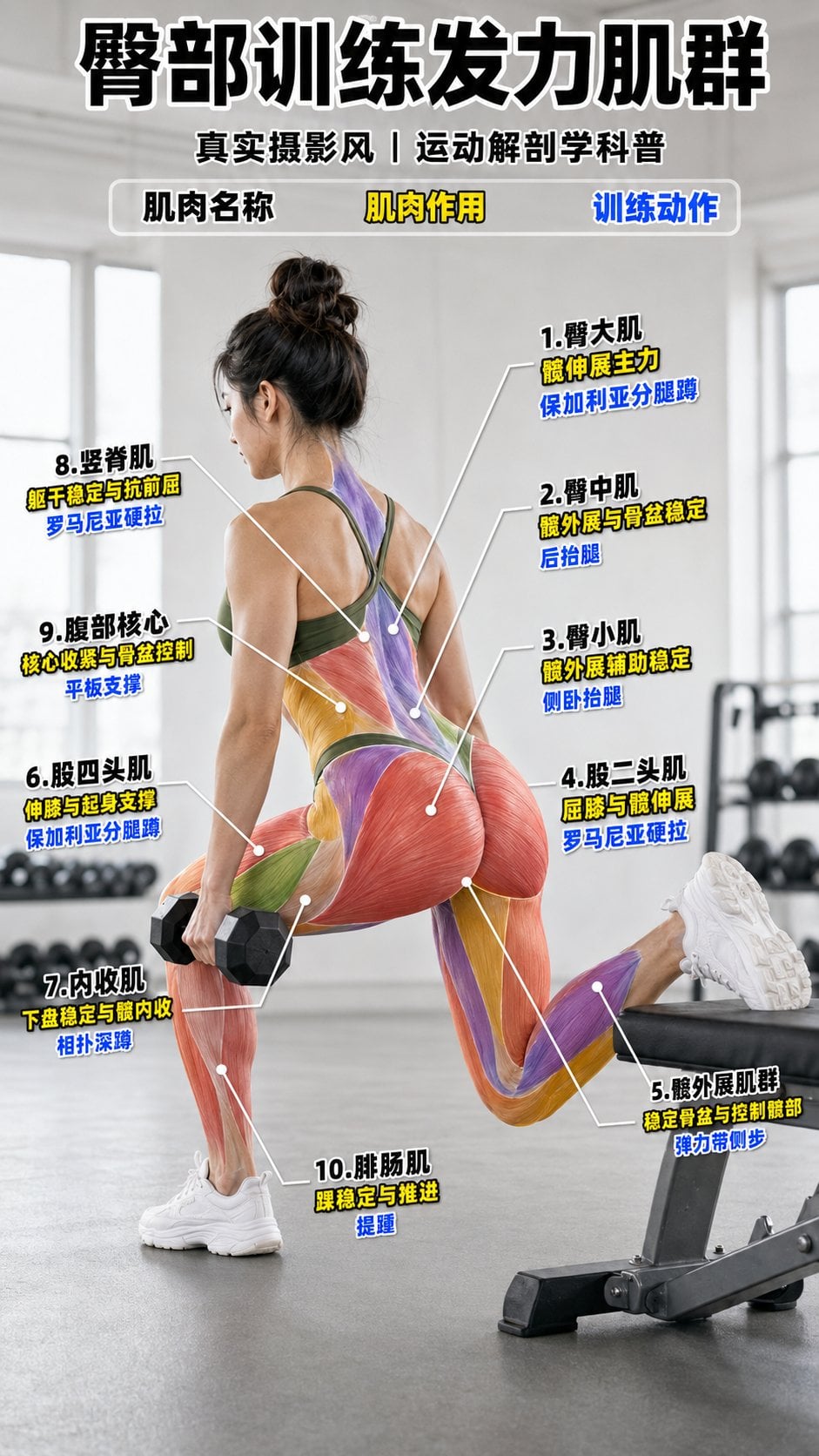
Fitness Anatomy Infographic Poster

Generated Image Preview

Fitness Anatomy Infographic Poster1 / 3
知识
知识猫图解
@GeekCatX
HomepageView original post
6KViewsJun 17, 2026
Model / Categories / LicenseGPT ImagePhotographyPoster DesignUI & GraphicCC BY 4.0

Infographic AI Image Prompt

Prompt

Generate a vertical, realistic photography style fitness anatomy infographic. The main subject is an adult young woman with a healthy and well-proportioned physique, wearing a solid-color sports bikini or minimalist two-piece sportswear. The overall style is professional fitness instruction, sports anatomy popular science, and social media fitness infographic. The clothing design is simple, athletic, not sexualized, intended to clearly reveal the shoulder, arm, chest, abdomen, waist, hip, and leg muscle areas for easy muscle labeling. If the target area is Glutes, the person adopts a 45-degree rear-side or side view, performing a peak glute bridge, Bulgarian split squat, leg raise, or Romanian deadlift pose, highlighting the gluteus maximus, gluteus medius, gluteus minimus, biceps femoris, and hip abductors. If the target area is Legs, the person adopts a front or 45-degree front-side view, performing a standard squat, lunge, sumo squat, or leg-focused pose, highlighting the quadriceps, biceps femoris, adductors, gluteus maximus, and gastrocnemius. If the target area is Abs, the person adopts a front or 45-degree side view, performing a crunch, plank, lying leg raise, or core contraction pose, highlighting the rectus abdominis, external obliques, transverse abdominis, lower abdomen, and iliopsoas. If the target area is Back, the person adopts a rear or 45-degree rear-side view, performing a lat pulldown, seated row, bent-over row, or back contraction pose, highlighting the latissimus dorsi, trapezius, rhomboids, erector spinae, and posterior deltoids. If the target area is Shoulders, the person adopts a front or 45-degree side view, performing a dumbbell lateral raise, dumbbell front raise, overhead press, or reverse fly pose, highlighting the anterior deltoids, medial deltoids, posterior deltoids, upper trapezius, and supraspinatus. If the target area is Chest, the person adopts a front or 45-degree front-side view, performing a standing cable fly, push-up top position, dumbbell bench press setup, or pressing pose, highlighting the upper pectoralis major, middle pectoralis major, lower pectoralis major, anterior deltoids, and triceps. If the target area is Arms, the person adopts a front or 45-degree side view, performing a dumbbell curl, hammer curl, triceps pushdown, or overhead triceps extension pose, highlighting the biceps, triceps, brachialis, forearm muscles, and anterior deltoids. The person's movements must be standard, with all limbs fully visible, clear center of gravity, and obvious contraction or stretching of the target muscle groups, suitable for instructional breakdown. The person is centered, full-body or three-quarter body composition, clear body outline. The background is simple and clean, such as a solid-color wall, minimalist gym, or light-colored indoor space, avoiding cluttered backgrounds. Overlay a semi-transparent colored muscle partition layer on the person's body surface, using red, yellow, green, purple, and orange to distinguish different muscle groups. The colored overlay areas should follow the human muscle lines, emphasizing the target training area and related synergistic muscle groups. The overall effect should resemble a fitness teaching poster combining realistic human photography with sports anatomy layers. The on-screen text uses a unified three-color labeling system: black bold text for Muscle Name, yellow bold text for Muscle Function, and blue bold text for Training Action. All text must have a clear white outline and slight shadow, with large and clear fonts, similar to Xiaohongshu or Douyin fitness popular science infographic style. Each muscle area uses a three-line text structure: First line: Muscle Name, Second line: Muscle Function, Third line: Training Action. Text is placed close to the corresponding muscle areas, arranged with a slight tilt along the body lines, with angles controlled between -25° and +25°, avoiding obstruction of the face, eyes, hands, knees, and key joints. The text information density is high, but readability must be maintained. A unified legend is kept at the top: Black text: Muscle Name, Yellow text: Muscle Function, Blue text: Training Action. The overall image has a vertical composition, high information density, vibrant colors, clear and sharp, realistic photography style, colored muscle partition overlay, Chinese fitness teaching labels, sports anatomy visualization, social media trending fitness popular science poster style, high definition, no watermark, no logo.

Use this Prompt