AI Image Models: Nano Banana vs GPT Image 2
Compare AI image generation models on ColabaseAI by speed, credit cost, prompt accuracy, aesthetics, and reliability to find the right model for your needs.
2026/07/11
Maintained and reviewed by ColabaseAI. This page covers the image models currently available in the ColabaseAI generation workflow: Nano Banana 2, Nano Banana Pro, and GPT Image 2.
The short answer is:
- Choose Nano Banana 2 for fast exploration and predictable 5-credit generations.
- Choose Nano Banana Pro for complex briefs and more polished Google-model creative work.
- Choose GPT Image 2 when text, output controls, or a choice of quality tiers matters most.
There is no single best AI image generator for every job. The useful choice depends on whether you are drafting, producing a final campaign asset, placing readable text in an image, or controlling cost.
This page is the current ColabaseAI catalog, capability, and credit-pricing reference. For a step-by-step creative workflow, use the linked guide near the end rather than treating this page as a tutorial.
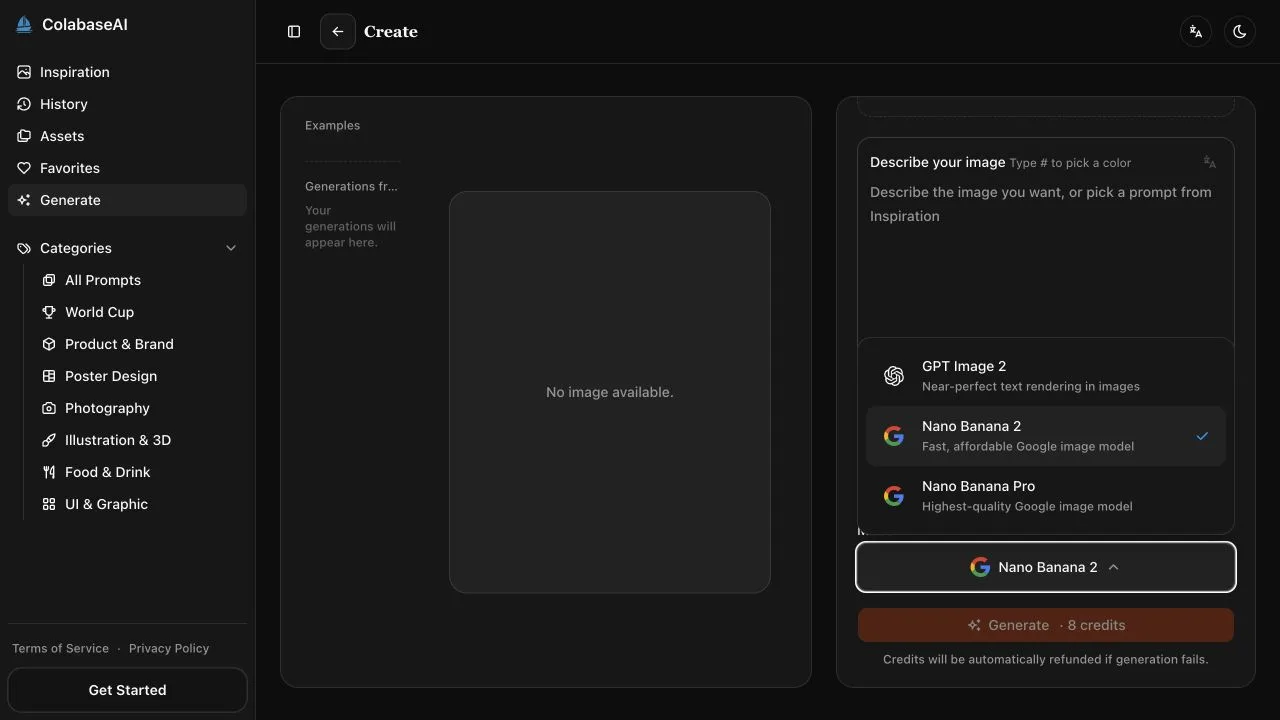
Quick AI image model comparison
| Model | Provider model | Speed position | Maximum resolution | Quality tiers in ColabaseAI | Minimum cost | Best starting point |
|---|---|---|---|---|---|---|
| Nano Banana 2 | Gemini 3.1 Flash Image | Optimized for fast, high-volume work | 4K | One platform tier | 5 credits | Drafts, iterations, everyday images |
| Nano Banana Pro | Gemini 3 Pro Image | Prioritizes complex, production-oriented work | 4K | One platform tier | 10 credits | Campaign visuals, detailed concepts, polished assets |
| GPT Image 2 | GPT Image 2 | Varies with resolution and quality | 4K | Standard, Medium, High | 2 credits | Text, layout control, reference-led work, final assets |
These are product positions, not laboratory scores. Actual generation time and output quality vary with the prompt, reference images, aspect ratio, resolution, quality setting, queue, and provider availability.
How we compare the models
This comparison uses four sources:
- The current model controls exposed in ColabaseAI, including resolution, aspect ratio, and quality options.
- Current ColabaseAI credit costs. These are platform credits, not provider API prices in US dollars.
- Official Google and OpenAI model documentation.
- First-hand observations from using the models in the ColabaseAI workflow.
We do not publish invented accuracy percentages, aesthetic ratings, or reliability scores. On this page, prompt accuracy means prompt adherence, aesthetics means the visual character and finish suited to a task, and reliability means how repeatable and controllable the workflow feels for that task. This is a practical comparison, not a controlled benchmark.
Nano Banana 2: best for fast iteration
Nano Banana 2 is ColabaseAI's speed-oriented Google image model. It maps to Gemini 3.1 Flash Image and supports 1K, 2K, and 4K output in the current product catalog.
Choose Nano Banana 2 when you need to:
- Test several compositions before committing to a final direction.
- Turn a prompt idea into quick social, blog, or campaign drafts.
- Explore different crops and aspect ratios at a predictable credit cost.
- Generate everyday visuals without choosing between multiple quality tiers.
Its main advantage is workflow speed and simplicity. You choose the resolution and aspect ratio, then generate at one platform quality tier. Google positions Gemini 3.1 Flash Image for speed and high-volume image generation.
The tradeoff is control. ColabaseAI does not expose separate Standard, Medium, and High quality tiers for Nano Banana 2. If the final asset needs tightly controlled text, a specific quality tier, or more deliberate production polish, compare the result with GPT Image 2 or Nano Banana Pro.
ColabaseAI price: 5 credits per image.
Nano Banana Pro: best for complex creative work
Nano Banana Pro maps to Gemini 3 Pro Image. It is the Google-model option to try when a brief contains several visual requirements or the result needs a more finished creative direction.
It is a strong fit for:
- Campaign key visuals and premium brand concepts.
- Detailed product scenes and high-fidelity mockups.
- Complex illustration briefs with multiple subjects or constraints.
- Graphic design tasks where composition and visual finish matter.
- A final Google-model pass after Nano Banana 2 has established the direction.
Google describes Gemini 3 Pro Image as optimized for professional asset production, including complex graphic design and high-fidelity product work. That does not mean it wins every prompt. A simple social draft may not benefit from the additional cost, and GPT Image 2 may be a better choice when quality tier control is the deciding factor.
Like Nano Banana 2, Nano Banana Pro supports 1K, 2K, and 4K output in ColabaseAI and uses one platform quality tier.
ColabaseAI price: 10 credits per image.
GPT Image 2: best for text and output control
GPT Image 2 is the OpenAI option in ColabaseAI. It supports 1K, 2K, and 4K output plus Standard, Medium, and High quality tiers.
Choose GPT Image 2 when you need:
- Short, readable text in posters, labels, covers, or ads.
- Explicit control over resolution and quality.
- Product visuals with deliberate layout and lighting instructions.
- Reference-image-led generation or editing.
- A low-cost Standard draft followed by a higher-quality final version.
The quality matrix is its clearest difference from the Nano Banana models. You can start at 1K Standard for 2 credits, then increase the resolution or quality only after the direction works. This makes GPT Image 2 both the lowest-cost entry point and the highest-cost option on this page, depending on settings.
Text rendering still needs a realistic brief. A short headline or product label is more dependable than asking any image model to typeset a full landing page. Keep the required words short, quote them exactly in the prompt, and plan to add long body copy in a design tool.
ColabaseAI price: 2 to 80 credits per image.
ColabaseAI credit pricing
Credit costs below describe generation inside ColabaseAI. They do not represent Google or OpenAI API prices and may change when provider or routing costs change.
Nano Banana pricing
| Model | 1K | 2K | 4K | Quality tiers |
|---|---|---|---|---|
| Nano Banana 2 | 5 credits | 5 credits | 5 credits | One platform tier |
| Nano Banana Pro | 10 credits | 10 credits | 10 credits | One platform tier |
GPT Image 2 pricing
| Resolution | Standard | Medium | High |
|---|---|---|---|
| 1K | 2 credits | 10 credits | 18 credits |
| 2K | 5 credits | 20 credits | 40 credits |
| 4K | 10 credits | 32 credits | 80 credits |
The default GPT Image 2 setting is 2K Standard at 5 credits. For all three models, the current catalog supports Auto plus common landscape, square, and portrait aspect ratios, including 21:9, 16:9, 3:2, 4:3, 5:4, 1:1, 4:5, 3:4, 2:3, and 9:16.
Current catalog decision summary
| Requirement | Start with | Catalog reason |
|---|---|---|
| Fast drafts and repeated exploration | Nano Banana 2 | Fixed 5-credit price and one quality tier |
| Lowest-cost individual generation | GPT Image 2 at 1K Standard | 2-credit entry point |
| Complex Google-model creative work | Nano Banana Pro | Positioned for professional asset production |
| Text and explicit quality control | GPT Image 2 | Standard, Medium, and High tiers |
| 4K output | Any of the three models | All currently support 4K in ColabaseAI |
These recommendations summarize the current catalog rather than prescribe a multi-step workflow. For practical prompting, iteration, and handoff guidance, read GPT Image 2 vs Nano Banana.
Free GPT Image 2 and Nano Banana prompt examples
The ColabaseAI AI prompt gallery is a free AI prompt library where each detail page pairs a copy-paste AI prompt with its real public image output. Start with these inspectable examples:
The public gallery groups Nano Banana 2 and Nano Banana Pro under the Nano Banana prompt family, because the same prompt can be tested with either current model. It does not claim that one gallery output is a controlled three-model benchmark.
Browse the gallery for free GPT Image 2 prompts, Nano Banana 2 prompts, Nano Banana prompt examples, and trending AI prompts before opening the generation workspace. Searches such as “ChatGPT Image 2 prompts” and “gpt-image-2 prompts” refer to the GPT Image 2 examples in this prompt gallery.
Frequently asked questions
What is the best AI image generation model on ColabaseAI?
For fast general work, start with Nano Banana 2. For complex, polished Google image generation, use Nano Banana Pro. For text and explicit quality control, use GPT Image 2. The best choice depends on the task rather than one overall ranking.
What is the difference between Nano Banana 2 and Nano Banana Pro?
Nano Banana 2 maps to Gemini 3.1 Flash Image and prioritizes speed and volume. Nano Banana Pro maps to Gemini 3 Pro Image and targets professional asset production and complex creative work. Both currently use one quality tier in ColabaseAI and support up to 4K.
Which model is cheapest?
GPT Image 2 at 1K Standard is the cheapest individual option at 2 credits. Nano Banana 2 costs a fixed 5 credits, Nano Banana Pro costs a fixed 10 credits, and GPT Image 2 rises to 80 credits at 4K High.
Which model is best for text rendering?
Start with GPT Image 2 when readable text is central. Nano Banana Pro is also worth testing for complex graphic design. Always proofread generated text and move long copy into a dedicated design tool.
Do all three models support 4K images?
Yes. Nano Banana 2, Nano Banana Pro, and GPT Image 2 support 1K, 2K, and 4K in the current ColabaseAI catalog.
Can I use a reference image?
The ColabaseAI generation workflow supports reference-led tasks where the selected model and provider path allow them. GPT Image 2 is a useful starting point when reference fidelity is important, but results still depend on the source image and prompt.
How fast is each model?
Nano Banana 2 is the speed-oriented option, while Nano Banana Pro prioritizes more complex production work. GPT Image 2 timing changes with resolution and quality. ColabaseAI does not publish fixed second-by-second promises because queue conditions, input complexity, and provider availability vary.
Sources and update policy
- Google Gemini 3.1 Flash Image model documentation
- Google Gemini 3 Pro Image model documentation
- OpenAI GPT Image 2 model documentation
This page was reviewed against the ColabaseAI model catalog and credit table on July 11, 2026. Model availability, platform credits, and provider capabilities can change. Recheck this page before planning a large production run, or contact ColabaseAI if a current setting is unclear.