2026 World Cup-Inspired AI Image Prompts: Posters, Match Day Graphics, and Fan Visuals
Use ColabaseAI to create unofficial World Cup-inspired football visuals with AI prompts for match day posters, fan graphics, watch party banners, fictional jersey concepts, and social media posts.
World Cup visuals move fast.
A match day poster may be needed today. A watch party banner may need to fit a wide livestream background, a vertical story, and a square social post. A fan graphic may need to feel energetic without looking like an official tournament asset.
That last part matters.
For most brands, creators, bars, communities, and fan accounts, the safer direction is not "make an official World Cup poster." It is "make a football tournament-inspired visual with original design, generic football elements, country-inspired colors, and no protected marks."
That is where prompt structure helps.
If you start with a blank prompt box, it is easy to write something vague like "make a football poster." The result may look exciting, but it often misses the format, leaves no room for text, uses random colors, or adds logos, player names, badges, trophy shapes, and sponsor-like marks you did not ask for.
ColabaseAI gives you a better starting point: browse World Cup-inspired prompt examples, inspect the prompt behind the image, adapt it to your own event or campaign, then generate variations with the model that fits the job.
As of this article's date, the 2026 tournament is already underway. If your visual includes matchups, dates, scores, venues, or broadcast details, verify them against the official FIFA match schedule before publishing.
Brand-safe prompt rules
This guide is for unofficial, fan-inspired football visuals.
When creating commercial or public-facing graphics, avoid asking the model to generate:
- Official FIFA logos, wordmarks, mascots, slogans, or tournament marks
- Real team crests or federation badges
- Sponsor logos
- Real player names, faces, or likenesses
- Exact replicas of official jerseys
- The official trophy design
- Designs that look like official tournament advertising
FIFA's own brand protection page states that it protects event-related brand assets such as logos, words, titles, symbols, and other identifiers. So your prompt should make the safe direction explicit.
Safer prompt language:
country-inspired color palette
generic football tournament atmosphere
fictional crest
original jersey concept
no official logos
no real player likeness
no sponsor marks
no protected tournament branding
The goal is to capture the energy of football season without making the image look officially affiliated with the tournament.
Start from the job, not the sport
"World Cup image" is too broad.
Before writing the prompt, decide what the image has to do.
| Use case | Best format | What the prompt should control |
|---|---|---|
| Match day poster | 4:5 or vertical | Country-inspired colors, generic player pose, headline space, stadium energy |
| Watch party banner | 16:9 | Wide composition, clear center area, date/time block, crowd mood |
| Social story | 9:16 | Big subject, bold typography, minimal clutter |
| Fan selfie visual | 4:5 or 1:1 | Stadium background, jersey-inspired colors, phone-camera realism |
| Legacy poster | 4:5 | Country palette, football celebration symbolism, landmarks, collectible layout |
| Fictional jersey concept | 1:1 or 4:5 | Fabric texture, front/back view, fictional badge placement, studio lighting |
The use case changes the prompt.
A poster needs hierarchy. A banner needs empty space. A social story needs one clear focal point. A fictional jersey concept needs material detail. A fan image needs atmosphere.
So the first line of the prompt should describe the job:
Create a vertical match day poster for an unofficial football fan campaign.
or:
Create a 16:9 watch party banner for a football viewing event.
That single sentence tells the model what kind of image to build.
Browse World Cup-inspired prompt examples first
Open the World Cup-inspired prompt category in ColabaseAI.
Do not copy the first prompt blindly. Look for the closest structure:
- A stadium crowd if you need energy
- A clean poster if you need typography
- A fictional jersey layout if you need apparel detail
- A collectible-style poster if you need a premium editorial look
- A fan selfie if you need social media realism
- A wide banner if you need a livestream or event header
When you open a prompt, read it like a creative brief. Ask:
- What is the main subject?
- What is the format?
- What colors does it control?
- Where does the text go?
- Does it use official logos, player names, or protected brand marks?
- What can you safely replace?
- Does the image still work if it is cropped for mobile?
- Is there enough empty space for the headline, score, date, or event details?
The goal is not to reuse every word. The goal is to borrow the structure.
The anatomy of a strong World Cup-inspired prompt
A useful football poster prompt usually has nine parts.
1. Asset type
2. Main subject
3. Format or aspect ratio
4. Country-inspired or event-inspired color palette
5. Scene or environment
6. Composition and text space
7. Mood and lighting
8. Style reference
9. Brand-safety constraints
For example:
Create a vertical match day poster for an unofficial football fan campaign.
Use a generic footballer silhouette in motion, a packed stadium at night,
country-inspired red and white color accents, dramatic floodlights, bold
poster composition, clear empty space at the top for a headline, premium
sports editorial style, no official logos, no real player likeness, no sponsor
marks, no protected tournament branding.
A prompt like this gives the model a clear job. It tells the model what to create, how to frame it, where the text should go, and what not to include.
Prompt example: match day poster
Use this when you need an announcement graphic for a game, viewing party, fan community, or social post.
Create a vertical 4:5 match day poster for an unofficial football fan event.
Show a generic footballer silhouette running toward a bright stadium tunnel,
dramatic floodlights, energetic crowd atmosphere, country-inspired blue and
white color palette, bold sports editorial composition, clear headline space
at the top, clean area near the bottom for match time and venue details,
high contrast, premium poster design, no official logos, no real player
likeness, no sponsor marks, no protected tournament branding.
This prompt works because it tells the model where the text belongs. That is more reliable than adding "with text" at the end.
Prompt example: watch party banner
Use this for livestream backgrounds, event pages, community posts, or website hero images.
Create a 16:9 watch party banner for a football viewing event. Show a wide
stadium-inspired background with cheering fans, flags as abstract color shapes,
warm evening lighting, clear empty center area for event title and date,
cinematic sports atmosphere, modern event poster style, no official logos,
no real player names, no sponsor marks, no protected tournament branding.
The key is the phrase "16:9 watch party banner." Without it, the model may build a vertical poster that does not fit your banner.
Prompt example: vertical social story
Use this for mobile-first content, countdowns, and quick fan posts.
Create a 9:16 football fan story graphic with one large football in the
foreground, stadium lights behind it, bold gradients inspired by
country-inspired colors, simple composition, large empty space in the middle for short
text, high-energy social media style, no official marks, no real players,
no sponsor logos.
For vertical stories, keep the composition simple. One subject, one text zone, and one strong color system are usually enough.
Prompt example: fan selfie visual
Use this when the image should feel candid and shareable.
Create a realistic 4:5 fan selfie-style image outside a football stadium at
night. Show a group of excited fans wearing generic red and white football
scarves, phone-camera perspective, bright stadium lights, festive crowd mood,
natural motion blur, no official team crests, no real player names, no sponsor
logos, no protected tournament branding.
For fan visuals, realism matters more than complexity. Keep the subject simple and put most of the detail into the scene and lighting.
Prompt example: fictional jersey concept
Use this for apparel concepts, merch previews, or sportswear moodboards.
Create a fictional football jersey concept displayed in a clean studio setup.
Use breathable fabric texture, subtle geometric pattern, country-inspired green
and gold color palette, front and back view, fictional badge placeholder,
premium product photography lighting, no official federation crest, no sponsor
logo, no real team branding.
This is the safest structure when your goal is design exploration rather than an official-looking replica.
Prompt example: collectible football poster
Use this when you want a premium poster that feels like a framed editorial piece.
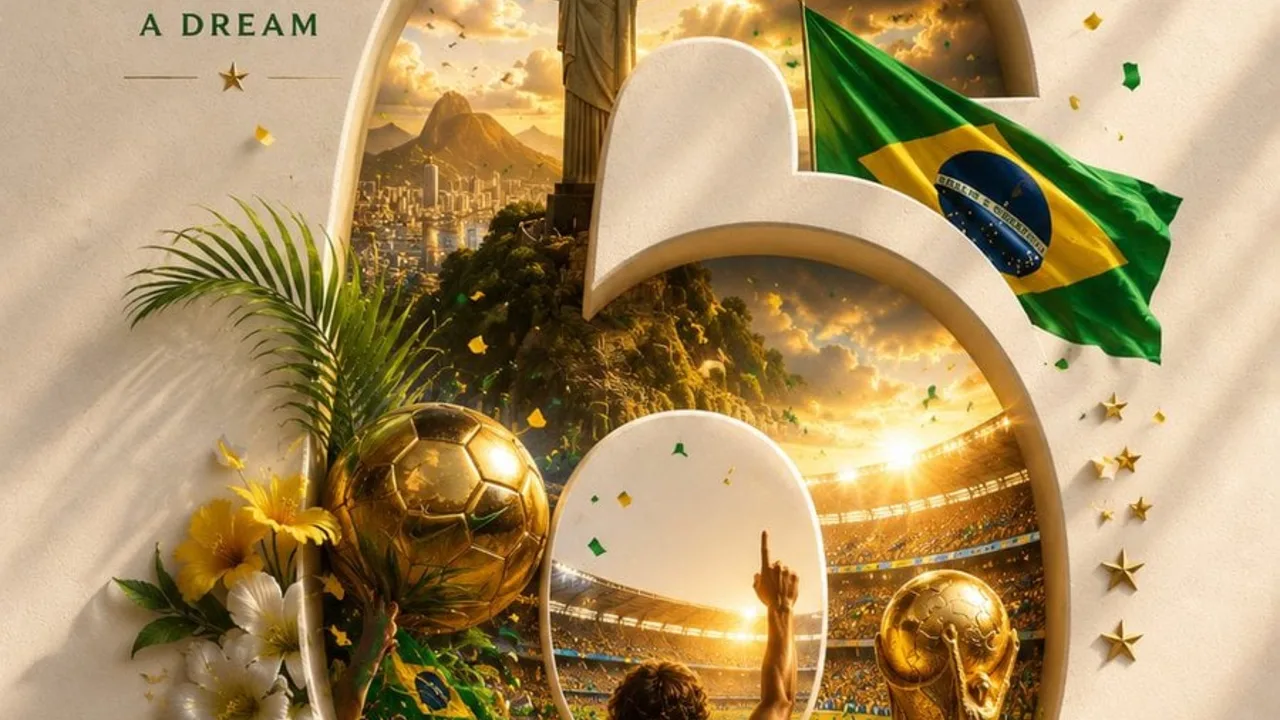
Create a collectible-style football poster inspired by an international summer
tournament. Show an abstract football, stadium architecture, city skyline
silhouette, country-inspired color palette, premium editorial poster layout,
subtle grain texture, clear title space, no official logos, no official trophy,
no real player likeness, no protected tournament marks.
This style is useful when you want something emotional and collectible rather than a direct game announcement.
Negative prompt ideas
Add these constraints when you want a safer unofficial visual:
no official logo, no FIFA logo, no official tournament mark, no real team crest,
no sponsor logo, no real player likeness, no player name, no official trophy,
no copyrighted mascot, no fake readable brand names
For text-heavy graphics, also add:
clean empty space for text, no random letters, no fake typography, no
misspelled words
These constraints are useful because image models often invent sponsor-like marks, badges, or fake typography unless you tell them not to.
Which model should you use for football graphics?
You can run the same World Cup-inspired prompt through different models in ColabaseAI. The best choice depends on the job.
| Task | Suggested model | Why |
|---|---|---|
| Quick match day draft | Nano Banana 2 | Fast iteration for multiple poster directions |
| Final poster with text space | GPT Image 2 | Better control over layout, size, and text-heavy compositions |
| Premium campaign visual | Nano Banana Pro | Stronger option for polished, complex creative assets |
| Fictional jersey concept | GPT Image 2 or Nano Banana Pro | Better for controlled product-style visuals |
| Fan selfie visual | Nano Banana 2 | Good for quick social-style variations |
If you are not sure, start cheap and broad:
- Use Nano Banana 2 to explore the mood.
- Pick the strongest composition.
- Rewrite the prompt with clearer layout and text instructions.
- Use GPT Image 2 or Nano Banana Pro for the final version.
If you are not sure which model to start with, read our GPT Image 2 vs Nano Banana model comparison.
A practical ColabaseAI workflow
Here is the simplest workflow:
- Open the World Cup-inspired prompt category.
- Pick an image close to your format: poster, banner, selfie, fictional jersey, or collectible.
- Open the prompt detail page and read the structure.
- Replace the subject, country-inspired palette, event name, and format.
- Add guardrails for logos, real people, betting, official marks, and extra text.
- Generate a few drafts with Nano Banana 2.
- Refine the best direction with GPT Image 2 or Nano Banana Pro.
- Save the final image and reuse the prompt for the next format.
If you are new to the product, start with the ColabaseAI prompt workflow guide.
Common mistakes
Asking for too much text
AI image models can struggle with long text blocks. Put one headline in the image and add detailed event information later in your design tool if needed.
Forgetting the output format
Always specify 16:9, 9:16, 4:5, 1:1, or the format you need. A good image in the wrong crop is still a problem.
Using official assets by accident
If you do not want official logos, say so directly. Add "no official logo, no team crest, no sponsor marks, no protected tournament branding" to the prompt.
Making every visual look like a stadium poster
World Cup-inspired content can also be fan selfies, snack tables, fictional jersey concepts, livestream backgrounds, editorial covers, or collectible art. Choose the format before choosing the style.
FAQ
What is the best prompt for a World Cup-inspired poster?
Start with the asset type, then define the subject, country-inspired palette, composition, headline area, and brand-safety constraints. A strong poster prompt is more about layout than adjectives.
Can I use official team logos in AI-generated images?
Only if you have the rights or a clear permitted use case. For general fan or marketing graphics, use country-inspired colors and generic football symbols instead.
Which model is best for match day graphics?
Use Nano Banana 2 for quick draft directions. Use GPT Image 2 when the poster needs readable text and tighter layout control. Use Nano Banana Pro for more polished campaign-style visuals.
How do I make a World Cup-inspired banner instead of a poster?
Say "16:9 wide horizontal banner" early in the prompt. Then describe where the headline, event details, and main subject should appear.
Can I reuse one prompt for multiple formats?
Yes, but change the composition section. A 4:5 poster, 9:16 story, and 16:9 banner need different subject placement and text spacing.
Start with a football visual that already works
You do not need to start from "make a football poster."
Start with the job: match day poster, watch party banner, fan story, fictional jersey concept, or campaign visual. Then choose a prompt structure that controls the format, subject, color palette, text space, and brand-safety constraints.
Open the World Cup-inspired prompt category in ColabaseAI, pick a visual direction, edit the prompt for your event, and generate a few variations before choosing the final version.